


The Left Education Project
The Left Education Project (LEP) is a collaboration between Democracy at Work and The Left Forum. LEP aims to provide activists, academics, and the socially conscious public with first-rate education on the pressing issues of our time. The inadequacy of mainstream media, political leadership, and educational institutions across all levels stems from a shared ideological reluctance to engage in meaningful social critique. In light of today’s national and international crises—economic, ecological, political, and military—this reluctance has particularly troubling consequences for society as a whole.
LEP offers courses on topics such as economics, healthcare, housing, the unhoused crisis, and mental disabilities, taught by accredited university professors, renowned professionals in their fields, and seasoned activists. Our series of lectures embodies collaboration among community members, students, and teachers, learning together to conduct a critical analysis of our shared experiences and develop solutions to the issues facing us all amid the collapse of capitalism.
Spring ‘26 Online Courses & Lectures:
“The Psychology of Capitalism & The Collapse of American Personal Life”
Psychology is the study of personal life and emotional relationships. This course will study the powerful institutions of marriage and family that have sustained people throughout the era of capitalism. They have been the basic emotional safety net for Americans. The nuclear family was formed alongside capitalism, and it is now failing as capitalism begins to fail.
Online, Tuesdays 4 - 6 pm EST

Harriet Fraad is a mental health counselor and hypnotherapist in practice in New York City. She is a founding member of the feminist movement and the journal Rethinking Marxism. For 40 years, she has been committed to transforming US personal and political life. Harriet specializes in speaking and writing about topics in which psychology, economics, and politics overlap. These topics remain loaded with taboos, confusions, ignorance, and fear preventing us from asking big questions and daring to discuss big answers. By analyzing issues where psychology, economics, and politics collide, we can better analyze our society and our individuality as well. (https://www.harrietfraad.com/). Her current podcast is called Capitalism Hits Home. Her latest book written with Stephen Resnick and Richard Wolff and edited by Graham Cassano is Class Struggle On The Home Front.
Special Offer:
This four-week, four-session online course is led by Professors Richard Wolff (The New School) and Shahram Azhar (Bucknell University). This course is designed to help participants learn to develop and apply critical analyses to institutions in society, such as the family, enterprises, markets, the state (legislatures, judiciaries, executives), schools, churches, police, military, and political parties, to gain a better understanding of how capitalism affects each one both separately and interwovenly.
Online, Wednesdays 4 - 6 pm EST

Richard D. Wolff is Professor of Economics Emeritus at the University of Massachusetts, Amherst, and currently a Visiting Professor of economics at the New School University, New York. Recent publications include Understanding Capitalism (2024), Understanding Socialism (2020), Understanding Marxism (2019), Contending Economic Theories: Neoclassical, Keynesian and Marxian [with Stephen Resnick] (MIT Press, 2012), Democracy at Work: A Cure for Capitalism (Haymarket, 2016). Wolff produces/hosts the weekly program, “Economic Update” broadcast on over 100 radio stations and to millions globally via TV networks, Substack and YouTube. All his work is available at www.democracyatwork.info and www.rdwolff.com.
Shahram Azhar is Associate Professor of Economics at Bucknell University, where he teaches courses in political economy and development economics. He has a PhD. Economics from UMass-Amherst and a Masters in Economics from the University of Warwick, in England. His research on digital capitalism, which has been published in numerous journals, seeks to understand how contemporary digital firms (such as Facebook, Amazon etc) exploit the global working class using elaborate supply chains. He serves on the editorial board of the preeminent journal Rethinking Marxism.

Late registration is now open for both Professor Wolff's and Dr. Fraad’s classes. To take advantage of this special offer, visit the Eventbrite page for either class and select the late-registration tier. This will get you access to the remaining three “live” online course sessions as well as the recordings of each—all for a discounted rate! Click below for access to this offer!
“Marxian Class Analysis”
Suggested Readings
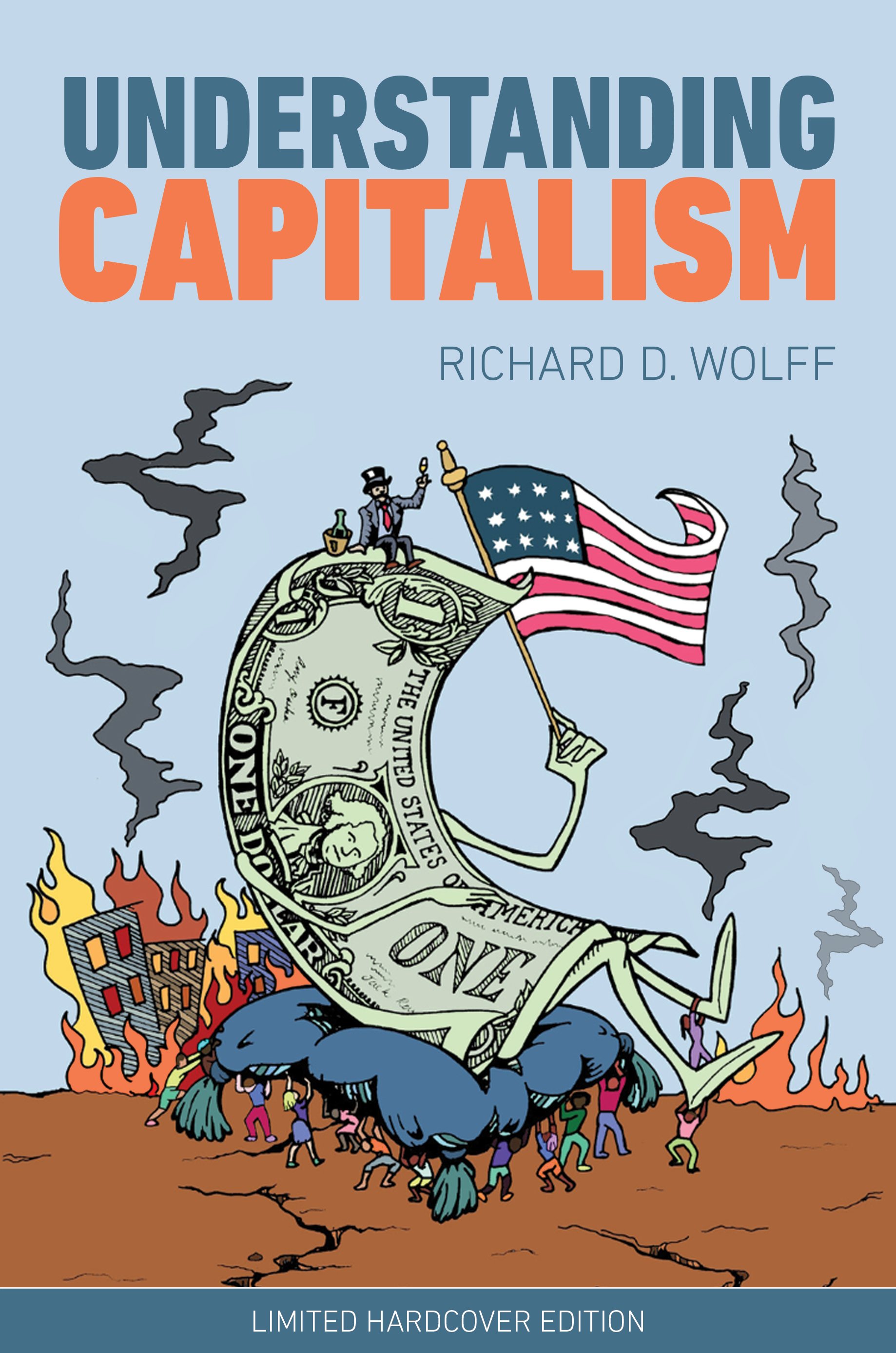
Understanding Capitalism aims to answer the question: "Why capitalism fails us"?. It explores the different definitions of what capitalism is and is not – showing why definitions matter. It dissolves the many myths that make it hard to understand the system. Readers acquire tools needed to engage basic economic and social issues of our time by showing precisely how they depend upon the capitalist system. Then the book shows how and where we can go beyond capitalism to specific alternative systems. Doing that, we argue, can and should be part of solving today’s great issues, of making the world better than we found it. (Also available in paperback here)

Why should we pay attention to the great social critics like Marx? Americans, especially now, confront serious questions and evidence that our capitalist system is in trouble. It clearly serves the 1% far, far better than it does the vast mass of the people. Marx was a social critic who did not regard capitalism as the end of human history. It was just the latest phase and badly needed to transition to something better. We offer this essay now because of the power and usefulness of Marx’s criticism of the capitalist economic system. Get your copy here.
In The State in Capitalist Society, Ralph Miliband argues that the state in capitalist societies, despite claims of neutrality, ultimately serves the interests of the dominant economic class. He challenges the liberal-pluralist view that power is diffused and shared, asserting that the state elite are closely connected to and drawn from the dominant class. Miliband's work explores how the state, through its institutions and actions, helps maintain and reproduce capitalist social relations.

This book shows in-depth, for the first time, how Palestine has become the perfect laboratory for the Israeli military-techno complex: surveillance, home demolitions, indefinite incarceration, and brutality to the hi-tech tools that drive the 'Start-up Nation'. From the Pegasus software that hacked Jeff Bezos' and Jamal Khashoggi's phones, the weapons sold to the Myanmar army that have murdered thousands of Rohingyas, and drones used by the European Union to monitor refugees in the Mediterranean who are left to drown. Israel has become a global leader in spying technology and defence hardware that fuels the globe's most brutal conflicts.